
Preprints: From Early Scholarly Exchange to Interactive Publishing Platforms
Development, Major Platforms, Open Review and the Practice of Global Century Press
Working draft | As of September 2026
1. What Is a Preprint?
A preprint is generally a scholarly paper or research output that is made publicly available before formal peer review and formal publication. Its core function is to temporarily separate “the dissemination of research” from “formal evaluation and certification by a journal or publisher”: researchers need not wait through a lengthy publication cycle, but can let peers see their work early, invite comments and create a traceable public record.
A preprint is not the same as a formal publication that has completed peer review. It may already be a fairly complete paper or research manuscript, yet it may still be revised. Several related concepts also need to be distinguished: a working paper usually emphasises “research in progress” and is especially common in economics, the social sciences and policy research; an accepted manuscript or postprint is a manuscript that has passed peer review and been accepted, but has not yet been formally typeset by the publisher; and the Version of Record is the final published version produced through the formal publishing process.
The main benefits of preprints include faster dissemination of knowledge, greater early visibility, wider feedback, a record of when research was produced that helps establish scholarly priority, and the promotion of Open Access and Open Science. At the same time, preprints require platforms and readers to distinguish clearly between “research not yet formally reviewed” and “formally published work that has completed peer review”.
2. The Development of Preprints: From Paper Exchange to Open Internet Platforms
Counted from large-scale, organised preprint exchange, this model has a history of at least sixty years; counted from modern internet preprint platforms, it has developed over roughly thirty-five years. Preprints did not suddenly appear in 1991; they grew gradually out of earlier scholarly correspondence, technical reports and the exchange of paper preprints.
| Date | Development | Significance |
| First half of the 20th century | Academic institutions, laboratories and disciplinary groups exchange research in advance through technical reports, preprints and the post. | Establishes a tradition of rapid scholarly exchange outside formal journal publishing. |
| 1961–1967 | The US National Institutes of Health (NIH) sets up the Information Exchange Groups (IEGs), systematically circulating unpublished manuscripts among life scientists by post. | An important pre-internet forerunner of large-scale preprint exchange, with more than 3,600 participants and 2,500 documents. |
| 1969 onwards | High-energy physics and other fields build preprint registration and exchange networks through research institutions and libraries, such as the services at SLAC. | Lays the foundation for a stable preprint culture in physics and its later digitisation. |
| 1991 | Physicist Paul Ginsparg sets up an electronic preprint distribution system at Los Alamos National Laboratory, which later becomes arXiv. | One of the key starting points of the modern internet preprint model, enabling rapid, global dissemination of research. |
| 1994 | SSRN (Social Science Research Network) is founded. | Brings large-scale online dissemination of working papers and early research to economics, law, management and other social sciences. |
| 1997 | RePEc (Research Papers in Economics) is formally established. | Aggregates economics working papers, articles and research materials through a distributed metadata network, another model of the social science preprint/working paper ecosystem. |
| 2013 | bioRxiv is founded. | The preprint model spreads rapidly in the life sciences, letting authors share findings and gain feedback before journal submission. |
| 2016 | The National Science Library of the Chinese Academy of Sciences builds ChinaXiv, supporting the posting, dissemination, download and commenting of preprints in Chinese and English. | Mainland China gains representative national-level preprint infrastructure, later adding open review, continuous versioning, peer review and journal links. |
| 2016 | The Center for Open Science launches OSF Preprints, also supporting disciplinary platforms such as SocArXiv, PsyArXiv and engrXiv. | Preprints extend further into the social sciences, psychology and engineering, strengthening open science infrastructure. |
| 2019 | medRxiv is launched. | Extends the preprint model to medicine and health sciences, stressing warnings that work is not yet peer reviewed and stricter screening. |
| 2024 | The Philosophy and Social Sciences Preprint Platform (PSSXiv), led by Renmin University of China and built by its Information Center for Social Sciences, goes online. | Chinese philosophy and social sciences gain an all-discipline preprint platform linking preprint release,timestamped records of first release, open review, online exchange, manuscript selection and journal publication. |
| 2020s (overall trend) | Open review, public peer review, author responses, version updating and the link from preprint to formal publication are becoming the new direction of development. | Preprints begin to shift from “early release” to “an open, interactive and traceable process of scholarly communication”. |
It should be stressed that although the modern internet preprint model is usually associated with arXiv in 1991, the scholarly tradition of the “preprint” clearly predates the internet. In 1961 the NIH Information Exchange Groups had already conducted a large-scale experiment, on paper and by post, with key functions later taken up by internet preprint platforms, such as “rapid dissemination, peer discussion and recording priority”. The key breakthrough of arXiv was to turn this mechanism of exchange into a low-cost, instant and globally accessible electronic network.
3. Why Open Access and Preprints Are Linked
arXiv developed during the same period as the rise of the internet and the World Wide Web. By enabling researchers to share their findings rapidly with peers worldwide, free from the constraints of traditional journal publication cycles, it became one of the important forerunners of later Open Access practice. Since then, preprint platforms have gradually formed an interconnected ecosystem of scholarly communication with Open Access, Open Science, open data and open peer review.
The significance of preprints for Open Access lies not only in “free reading”. Preprints change the point at which research enters the public scholarly space: where work once could be widely read only after formal publication, it can now circulate before formal review; where peer comments once existed only among authors, editors and anonymous reviewers, some platforms now make comments, review reports, author responses and revision histories public as well. Scholarly communication is thus expanding from a single final publication into a continuous record in which the formation of research can be observed.
4. Major Preprint and Working Paper Platforms Today
4.1 Natural Sciences and Interdisciplinary Fields
- arXiv: Covers physics, mathematics, computer science, statistics, quantitative biology, quantitative finance and other fields. It is one of the earliest and most influential platforms of the modern internet preprint era. Its main features are rapid public release, long-term preservation, version updating and stable citation.
- bioRxiv: Founded in 2013 by Cold Spring Harbor Laboratory for the life sciences. Manuscripts undergo basic screening before posting, which is not equivalent to peer review. Authors can make their research public, receive feedback and update versions before formal journal submission.
- medRxiv: Launched in 2019 for medicine, clinical research and health sciences. Because medical research may directly affect clinical practice and public behaviour, the platform places particular emphasis on risk warnings and pre-posting screening.
- Zenodo: A general-purpose open research repository supported by CERN, able to host drafts, data, software, reports and many other research outputs. It is not a dedicated preprint server, but is widely used for open deposit, version records and DOI assignment.
4.2 Social Sciences and Humanities
- SSRN (Social Science Research Network): Founded in 1994, covering economics, law, management, finance, political science, sociology and more. It is one of the oldest and largest working paper / research paper networks in the social sciences. Many studies circulate through SSRN before formal journal publication.
- SocArXiv: A non-profit, open preprint platform for the social sciences, launched in 2016 as one of the disciplinary services of OSF Preprints, emphasising free, open and public scholarly infrastructure.
- RePEc (Research Papers in Economics): Formally established in 1997 with a focus on economics. Rather than a single centralised server, it brings together information on research institutions, working papers, journals and authors worldwide through distributed metadata collaboration.
- PsyArXiv: An open preprint platform for psychological research, likewise built on open science infrastructure.
- OSF Preprints: Open preprint infrastructure built by the Center for Open Science. It provides underlying support for preprint communities in many disciplines and promotes the integration of cross-disciplinary search, open materials and research workflows.
The preprint ecosystems of the social sciences and the natural sciences are not identical. Economics has long relied on working papers for scholarly exchange, and law, management and social policy have also developed early-dissemination traditions different from that of physics. As a result, “preprint platforms” in the social sciences often include many forms at once: preprints, working papers, research reports, discussion papers and institutional papers.
5. Preprints in China and in Chinese-Language Scholarship
The development of preprints in China and in Chinese-language scholarship has followed a path that is connected with international platforms while reflecting its own institutional and publishing environment. Mainland China now has a national-level platform and a platform dedicated to philosophy and the social sciences; Hong Kong mainly uses university institutional repositories to preserve and openly share preprints and postprints; and Taiwan has developed fairly systematic Chinese-language resources on academic ethics, preprint norms and open science education. For Macau, this search found no comprehensive independent preprint platform comparable to ChinaXiv or PSSXiv, so the discussion below focuses on representative practices that could be verified.
5.1 ChinaXiv: The Chinese Academy of Sciences Preprint Platform
ChinaXiv was established in 2016 by the National Science Library of the Chinese Academy of Sciences (CAS), under the auspices of CAS and with support from the CAS Bureau of Science Communication.It is a preprint exchange platform operated in line with international norms. Its guiding principles are “led by the scholarly community, serving the public good, efficient exchange and open dissemination”. It supports the posting, dissemination, download and commenting of preprints of scientific papers in Chinese and English, and is positioned as national-level preprint infrastructure supporting a new system of scholarly communication.
ChinaXiv 2.0, launched in 2022, added open review, paper annotations, continuous version updating and submission recommendations. Researchers can not only release findings quickly but also keep updating versions and initiate peer review; journals can cooperate with the platform on commissioning papers, priority selection of manuscripts and preprint deposit. The platform states clearly that preprints undergo preliminary screening but not rigorous peer review, and are subject to open post-publication review; the formal journal version can form a complete version chain with the preprint, linked through the DOI and the final publication link.
ChinaXiv is also advancing a collaborative model of “posting on a preprint platform, publishing in an academic journal”. Its partner-journal policy, for instance, already covers plagiarism checking, initial assessment, language editing, open review, online-first publication, post-publication review and the recommendation of outstanding papers; in 2024 it also launched a rapid preprint review and publishing programme with CSIRO Publishing. This shows that preprint practice in China has moved beyond simple open deposit towards version updating, open review and links to formal publication.
5.2 The Philosophy and Social Sciences Preprint Platform (PSSXiv)
The Philosophy and Social Sciences Preprint Platform (PSSXiv; Chinese: 哲社预印本) is led by Renmin University of China and built by the university’s Information Center for Social Sciences. It is a sub-platform of “Academic World”, a digital innovation platform for China’s autonomous knowledge system in philosophy and the social sciences, and the first preprint platform in China to cover all disciplines of philosophy and the social sciences. Its principles are summarised as “co-creation by scholars, rapid release, open sharing and efficient dissemination”, and it serves authors, readers, journals, academic institutions and relevant practitioners.
This platform deserves particular attention from social science and humanities publishers, because its services go beyond the basic “upload–download” model to cover initial screening, preprint release, timestamped records of first release, open review, online exchange, manuscript recommendation and selection, reprinting, selection of core literature, multimedia dissemination and the application of research. Its other main features include “machine detection plus human review”, trusted time-stamping, and coordination among the platform, journals and authors.
The actual workflow between the platform and its partner journals clearly reflects a full-chain model: “rapid screening – preprint release –timestamped record of first release– open review – online exchange – recommendation and selection – journal publication – selective reprinting – multimedia dissemination”. In Chinese-language philosophy and the social sciences, therefore, preprints have begun to form institutionalised links with open review, journal selection and formal publication.
5.3 Hong Kong: Mainly Preprints/Postprints in University Institutional Repositories
The representative practices that can be clearly verified in Hong Kong are concentrated mainly in university institutional repositories. The University of Hong Kong’s HKU Scholars Hub maintains Preprints/Postprints collections in many faculties and disciplines, including Chinese, English, history, linguistics, education, law, science and medicine, showing that preprints and postprints are systematically preserved and disseminated as part of the institutional Open Access system. The Hong Kong Polytechnic University’s PolyU Institutional Research Archive likewise serves as an Open Access institutional repository, allowing researchers to submit manuscripts while the library handles copyright issues and determines when an appropriate version can be made openly available.
The main role of such institutional repositories is preservation, Open Access and greater visibility of research. This differs from the comprehensive preprint workflows of ChinaXiv and PSSXiv, which centre on open review, author responses, version updating and coordination with journals.
5.4 Taiwan and Macau: Preprint Norms, Open Science Education and Institutional Repositories
Taiwan already has fairly systematic public resources on Chinese-language preprint terminology, academic ethics and publishing norms. The Center for Taiwan Academic Research Ethics Education defines a “preprint” as a complete research draft that has neither undergone peer review nor been formally accepted by an academic journal, and provides an entry on “preprint servers”, thematic teaching materials, courses and guidance on publication ethics. These materials stress the value of preprints for rapid dissemination and Open Access, while also discussing duplicate submission, redundant publication, version tracking and research quality.
From this search, Taiwan’s emphasis at present lies in the use of international preprint systems and in education on open science and publication ethics; no comprehensive independent preprint platform comparable in scale to ChinaXiv or PSSXiv, serving the whole Chinese-language scholarly community in Taiwan, was found. Nor did this search find a comparable comprehensive platform in Macau. The phrase “not found in this search” is used to avoid presenting an absence of search results as proof of non-existence.
5.5 Implications for the GCP Platform’s Positioning
These practices in China and Chinese-language scholarship show that “interactivity” in itself is no longer a distinctive feature that GCP can claim. ChinaXiv already offers open post-publication review, continuous version updating, peer review and links to journals; PSSXiv places even greater emphasis on a complete chain of open review, online exchange, manuscript recommendation and selection, and journal publication. GCP’s distinctiveness should therefore be built on these existing practices: bringing the social sciences and humanities, global and comparative China studies,bilingual publishing, and the GCA Institutional Series, GCP Academic Journals & Periodicals and GCP Book Series together on a single publisher-led platform, and incorporating forthcoming books, tables of contents, sample chapters, author notes, reader feedback and pre-orders into a continuous “Preprint to Publication” process.
6. From “Preprint Repositories” to “Interactive Preprints”: A New Direction
The core function of early preprint platforms was “upload – release – download”. In recent years a more interactive model has emerged: once a preprint is public, peers can review it openly, authors respond to reviews and submit revised versions, reviews and version histories are retained, and some platforms link this process directly to formal publication. Preprints are thus no longer merely “unpublished files”, but are gradually becoming vehicles for open peer review and scholarly dialogue.
- F1000Research: Uses an open “publish first, peer review afterwards” model. Articles are made public immediately after basic editorial checks; invited experts then review them openly, with reviewer identities and reports visible; authors can respond point by point and upload revised versions; and all versions and review records are permanently retained.
- eLife Reviewed Preprints: Brings the preprint, the eLife Assessment, Public Reviews and author responses together in a single public record. Authors may continue to submit revised versions and finally choose to produce a formal Version of Record.
- Review Commons: Provides journal-independent peer review. Its Refereed Preprint comprises the author’s manuscript, one round of peer review reports and the author’s response, and can be transferred to partner journals to reduce duplicate reviewing and shorten the publication process.
- Peer Community In (PCI): Research communities provide free peer review and recommendation of manuscripts already posted on preprint servers. The reviewed version, the recommendation text, the reviews and the author responses form a public record and may proceed to relevant journals.
- PREreview: Emphasises community-based preprint review. Researchers can request reviews, submit structured or full reviews, and take part in collective, interactive reviewing through Live Reviews and Review Clubs.
- ScienceOpen: Provides tools for preprints, public comments, open peer review, author responses and version management. Comments and reviews are linked to specific versions and the full history is visible, making it suitable for publishers and journals building their own open review workflows.
- Sciety: Created by eLife to aggregate public reviews and curation of preprints from multiple communities. It works more like a “preprint evaluation aggregation and discovery platform”, helping readers find research that has already been discussed and evaluated across different review communities.
These platforms show that interactive preprints are forming a new logic of scholarly communication: research does not jump directly from “unpublished” to “formally published”, but moves through an observable, traceable continuum of public dissemination, peer discussion, author response, version updating and formal publication.
7. Main Advantages of the Preprint Model and Issues Requiring Attention
- Rapid dissemination: research can enter scholarly exchange early, without waiting months or longer for formal peer review and scheduling.
- Establishing priority: public dates and version records help show when research was produced and made public.
- Wider feedback: feedback is no longer limited to two or three anonymous reviewers, but may come from the broader scholarly community.
- Greater visibility: research can be searched, read, discussed and cited before formal publication.
- Promoting Open Access: access barriers to knowledge are lowered, making research easier to reach for readers in different regions and institutions.
- Preserving the evolution of research: version records such as v1, v2 and v3 show how authors revise their research in response to feedback.
- Linking to formal publication: more and more platforms are exploring ways to move preprints and their reviews directly into journal publishing workflows.
At the same time, preprints require clear scholarly and publishing norms:
- Manuscripts that have not completed formal peer review must be clearly labelled, so that readers do not mistake them for formally certified scholarship.
- Medicine, health and other high-risk fields require stricter screening and risk warnings.
- Version numbers and posting dates should be retained to avoid confusion in citing and understanding different versions.
- Open commenting does not mean that all content is published automatically; editorial moderation, codes of conduct and spam management are needed.
- The relationship between preprints, open review and formal peer review should be clearly explained, so that general comments are not confused with formal peer review.
- Authors, reviewers, editors and ordinary registered users should have different permissions, and rules on conflicts of interest and research ethics should be established.
8. Why Global Century Press Has Established Its Own Preprint Platform
Building on Global Century Press’s long-standing focus on the social sciences and humanities, global and comparative China studies, andbilingual publishing, we have established a small preprint and forthcoming-publications platform built into the press website. Its purpose is not to replicate arXiv, SSRN or other large comprehensive platforms, but to connect early dissemination, open exchange, version development and formal publication within the press’s existing scholarly publishing system.
The platform covers three types of content: first, working papers, Dialogue papers, Fellowship-related papers and other research outputs in the Global China Academy (GCA) Institutional Series; second, preprints, forthcoming articles and related commentary from Global Century Press’s academic journals and periodicals; and third, forthcoming books and book series, including book announcements, tables of contents, sample chapters, author notes and pre-order information. This preserves the distinctive features of each publication type while creating, through a single platform, an interconnected space for pre-publication scholarly exchange.
9. GCP Platform’s Core Feature: Interactive “Preprint to Publication”
Compared with traditional preprint platforms whose main functions are “deposit and download”, the most important feature of this platform is that it brings authors, readers, reviewers and the publisher into a single interactive process of scholarly communication. The platform does not simply post PDFs online early; it enables research to be read, discussed, reviewed, answered and revised before formal publication.
The core workflow is “submit – read – comment – review – respond – revise – publish”. Authors first submit a preprint or working paper;the press conducts basic checks for scholarly standards, research ethics and editorial compliance; once the manuscript is public, readers and peers can post comments or questions, andqualified reviewers can submit structured Reviews; authors can respond publicly and upload new versions such as v2 and v3 in light of the feedback; and when the manuscript enters formal publication, the preprint page is retained and linked to the DOI and to the formal journal article, periodical article or book page.
This model shares a common direction with international open review practices such as F1000Research, eLife Reviewed Preprints, Review Commons, PCI, PREreview and ScienceOpen, and echoes the open review, version updating and journal links being developed by ChinaXiv and PSSXiv in mainland China. What distinguishes the GCP platform is not a claim to have “achieved interactivity for the first time”, but the way it brings different types of pre-publication output into a single publisher’s system, drawing on its own positioning in the social sciences and humanities, global and comparative China studies,bilingual publishing, and the GCA Institutional Series, journals, periodicals and book publishing. In particular, by incorporating forthcoming books, sample chapters, tables of contents, author notes, reader feedback and pre-orders into the interactive platform, it brings books too into a process in which they can be read, discussed and revised and are linked to formal publication. Compared with most preprint services, which focus on journal articles, this better reflects the character of a publisher.
10. Interactive Functions the Platform Should Provide
- Status & Versioning: Each item displays a clear status at the top, such as Preprint v1, Open for Comments, Under Review, Author Response Available, Revised v2 or Formally Published. Each revision retains its version number, upload date and version history; the preprint record is kept after formal publication.
- Author Submission: Provide Submit a Preprint / Submit a Working Paper. Authors submit the manuscript, abstract, keywords, author information, series and any necessary attachments. Manuscripts should not be published automatically without screening, but should first pass the press’s basic review.
- Read, Download & Comment: Each item page shows the abstract, keywords, authors, posting date, version number, series and Read / Download. Registered readers can post comments or ask questions; comments can be moderated, hidden or closed from the back end.
- Open Review: Provide Comment or Review.General comments are kept separate from structured Reviews.A Review may includeOverall Comment, Major Points, Minor Points and Recommendation; reviews may be signed or anonymous according to platform rules.
- Author Response & Revision: Authors can post an Author Response tocomments or Reviewsand submit new versions. Earlier versions are retained, forming a clear, traceable record of the version history.
- Link to Formal Publication: Once a work is formally published, the preprint page displays Published Version Available and links to the DOI, the formal journal or periodical article, the book page and the WooCommerce purchase or pre-order page.
- Interaction Indicators: Labels such as Preprint v1 | Open for Comments | 3 Reviews | 5 Comments | Author Response Available | Revised v2 can be shown near the title, so readers can see at a glance what stage a manuscript has reached.
- Users & Permissions: Distinguish between Author, Reader / Registered User, Reviewer and Editor / Admin. All public comments, Reviews, author responsesand version uploads should be managed by the press through the back end.
- Notifications & Analytics: Gradually add email notifications and statistics such as views, downloads, comments, reviews and latest revision date, so that authors and editors can follow the dissemination of and engagement with each manuscript.
- Openness & Publication Statement: Every preprint should state clearly whether it has completed formal peer review. For example: This preprint has not yet undergone formal peer review. Manuscripts that have entered open review or formal review display the corresponding status.
11. Different Levels of Interaction for Three Types of Content
- GCA Institutional Series: For working papers, Dialogue papers, Fellowship-related papers and the like. Comments, Reviews, author responsesand version updates can be opened, highlighting the exchange and development of the Academy’s research outputs.
- GCP Academic Journals & Periodicals: The highest level of interaction. Preprints, public comments, structured peer review, author responses, version updates and the formal journal version can be fully linked.
- GCP Book Series: Focused on forthcoming books: book announcements, tables of contents, sample chapters, author notes and reader feedback can be published and linked to pre-orders. Depending on the project, sample chapters or complete manuscripts may be opened for comment and expert review, without mechanically replicating the peer review model for journal articles.
12. The Intelligence Age and the Rise of Preprints in the Humanities and Social Sciences
12.1 Why the Humanities and Social Sciences Long Lacked a Preprint Tradition
The modern form of the preprint developed mainly in physics, the life sciences and medicine. In these fields research moves quickly and competition is concentrated, so the timing of disclosure bears directly on academic priority; this gave rise to the tradition of “disclose first, review later”. The humanities and social sciences are different. Research cycles are longer, findings are usually presented in monographs and long articles, and academic evaluation values the completeness and maturity of an argument rather than being first to publish.
Yet the humanities and social sciences are not without comparable practices. Working papers in economics, discussion papers from policy institutes, conference papers and institutional paper series are all, in essence, forms of public circulation before formal publication. They have simply been scattered across different names and channels, without coming together under a unified concept of the “preprint”.
We ourselves have engaged in such a practice. Between 2009 and 2013, at the London School of Economics and Political Science (LSE), we founded three scholarly publications: the Bijiao: China in Comparative Perspective Working Paper Series (ISSN 2043-0434), the online Bijiao: China in Comparative Perspective Book Review (ISSN 2045-0680), and the Journal of China in Comparative Perspective (JCCP, ISSN 2040-0837). Of the three, the journal operated anonymous peer review and published finished research; the book review published texts after editorial approval, which were likewise formal publications; only the working papers made public research that was still under review and revision. The journal was edited while we were at LSE and has been formally published since 2015; after the book review ceased publication, it was merged into the journal as its book review section; and some of the working papers were published in the journal after peer review. The working papers followed precisely the path of “disclose first, review later, then publish formally”, except that at the time they were called “working papers” rather than “preprints”.
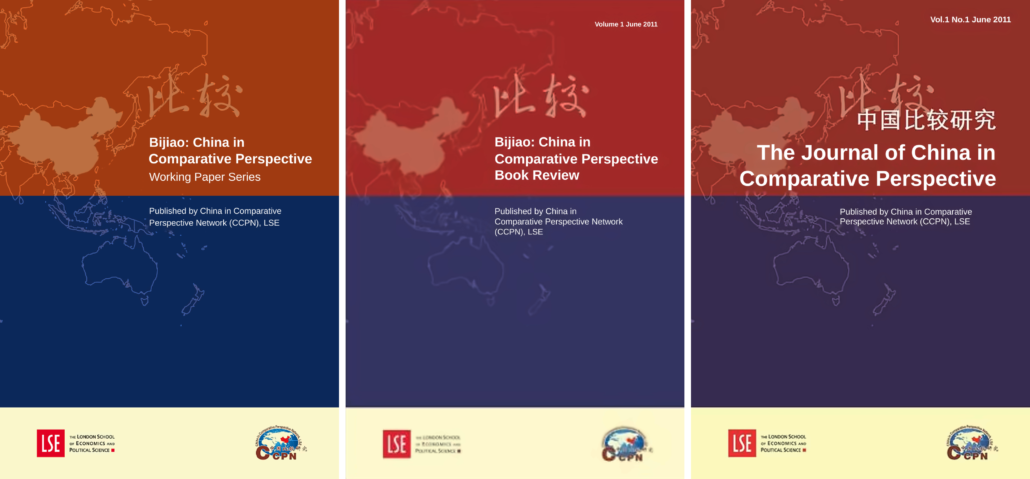
Figure 1. Covers of the three publications of the China in Comparative Perspective Network (CCPN), LSE, 2011: the Bijiao: China in Comparative Perspective Working Paper Series (left), Bijiao: China in Comparative Perspective Book Review, Vol. 1 (centre), and The Journal of China in Comparative Perspective, Vol. 1, No. 1 (right).
This path continues today. The English working paper by Kent Deng and Jane Du, “Domestic Savings-Driven Growth: Unveiling Internal Economic Dynamics in China, 1980–2010”, was released in the LSE institutional repository in 2024. Translated by XU Haiyan and slightly abridged, it was published in Chinese as 《家庭储蓄驱动型增长:1980—2010年中国经济发展内在机制探析》 in the “Translated Research by Distinguished Scholars” section of our Journal of Chinese for Social Science (JCSS), Volume 4, 2025 (DOI: 10.24103/JCSS4.cn.2025.6). The translator, XU Haiyan, has been involved in translation and editorial work for LSE’s China in Comparative Perspective Network since 2013. In moving from an English working paper to a formal Chinese publication, this translation illustrates both the path “from preprint to publication” and the fusion of Chinese and English scholarly exchange in the sense of transculturality.
Such practice was possible only because we had a website. Before online platforms existed, working papers could circulate only in print among small circles, and it was hard for a research network to make unfinished research available to readers worldwide at low cost. It was the website that allowed us to organise working papers into a series, obtain an ISSN, and publish them to the world. At that time, however, the website was merely part of an institutional web presence. The working papers depended on a particular research network and its funding, and lacked persistent identifiers, version records and any mechanism for public discussion. Papers were simply posted online: readers had no way to respond, and authors could not revise in light of feedback. Once institutional conditions changed, the series ceased publication.
Today we still have a website, but the environment has changed fundamentally. On the one hand, open access and open science have become a consensus in the international academic community; persistent identifiers (such as DOIs), version management and preprint platforms have all matured, and the humanities and social sciences have begun to build their own preprint channels. On the other hand, the Intelligence Age has changed the pace of knowledge production: the writing, dissemination and review of research are all accelerating, and human–machine collaboration raises new questions of authorship, provenance and review. Against this background, the preprint can no longer be merely an ancillary publication format of a single research network; it needs to become an independent platform with deliberate institutional design. The working paper series of the past was a spontaneous experiment of the website era; the preprint platform we are now formally building is a conscious response, in the Intelligence Age, to how scholarly communication in the humanities and social sciences should work. Its purpose is to provide a formal, citable and traceable channel for first publication of research in the humanities and social sciences. Unlike the working papers of the past, which could only be posted online, this is an interactive platform: any reader can take part in commentary and discussion, and authors can revise their work accordingly before it proceeds to formal publication, making scholarly communication more open and transparent.
Whether preprints can take root in the humanities and social sciences, however, depends not only on technology and platform building but also on the institutional environment. Many journals in these fields use double-blind peer review and emphasise original first publication, so authors worry that a preprint may reveal their identity or be treated as duplicate publication. Although many international publishers have in recent years explicitly permitted authors to post preprints before submission, such concerns remain widespread in the humanities and social sciences.
In the Chinese academic environment, an evaluation system centred on core journals makes it difficult for preprints to count as research output. Chinese-language preprint infrastructure in mainland China also emerged relatively late: ChinaXiv was established in 2016 and focuses mainly on science and engineering, while PSSXiv, serving philosophy and the social sciences, was launched only in 2024 and has begun to offer open review and recommendation of manuscripts to journals. Book publishing, meanwhile, remains largely outside the preprint system, and this is precisely where a publisher’s preprint platform can make a contribution: connecting readers in China and abroad through Chinese–English bilingual publishing, and extending preprints to book publishing, so that the path “from preprint to publication” leads not only to journals but also to monographs.
12.2 What The Intelligence Age Changes
Technological development, represented by artificial intelligence, is changing how scholarly knowledge is produced, disseminated and evaluated, and has brought the significance of preprints for the humanities and social sciences back into focus. The first change is a lowering of language barriers. Machine translation and AI-assisted writing make simultaneous publication in Chinese and English, and even in multiple languages, possible: Chinese research can enter international scholarly exchange earlier, and international research can be read and discussed more quickly by Chinese scholars. As language barriers fall, the circulation of knowledge accelerates. The cycle in which ideas and concepts are disseminated, cited and reworked has been greatly compressed, and research in the humanities and social sciences, too, now faces the question of “who said it first”. The importance of publication dates and version records has risen accordingly.
At the same time, generative AI has made producing text easier than ever before, and academic credibility needs new safeguards. The traceability of how research takes shape is becoming an important supplementary basis for judging originality and credibility, and the version history, time records, public review and author responses of preprints can provide exactly this kind of process record. Review itself is also expanding: AI can assist with format checking, literature organisation and preliminary analysis, and is entering editorial and review workflows, complementing human peer review. The use of AI, however, must be clearly disclosed and must follow the principles of transparency, accountability and research integrity; final judgement and responsibility should remain with editors and scholars.
12.3 Towards Convergence: The New Significance of Preprints in the Humanities and Social Sciences
In this context, preprints in the humanities and social sciences are no longer a simple transplant of practice from the sciences, but the product of multiple forms of fusion. On the one hand, the scientific mode of communication, “rapid disclosure, open review”, is fused with the humanistic and social-scientific tradition that values argument and dialogue; and Chinese and English scholarly exchange are fused in the sense of transculturality, rather than remaining one-way translation and introduction.
On the other hand, scholarly judgement is fused with the support of intelligent technology, with AI taking on supporting work while academic judgement remains with scholars; and pre-publication scholarly exchange is fused with formal publication, so that the preprint is no longer a draft detached from publishing but an integral step towards formal publication. These forms of fusion were difficult to achieve together in the past; the Intelligence Age provides new technological and communicative conditions for bringing them further together.
12.4 Our Response
It is against this background that we have established our own preprint platform. This is not a sudden initiative: from founding the working paper series at LSE in 2009 to translating English working papers for formal publication in Chinese today, we have long been exploring the path “from preprint to publication”. The preprint platform continues this exploration and sets it on the road to institutionalisation in the Intelligence Age. It takes a practice long dominated by the sciences, and scattered across the social sciences under names such as “working papers”, and reorganises it in the context of the social sciences and humanities, Integrated Dual-Language Publishing (IDLP) and book publishing. “Interactivity” in itself is no longer a feature we can claim as unique; but extending preprints to forthcoming books, and combining them with Integrated Dual-Language Publishing, remains rare among existing platforms. This is a genuine gap we have identified, and the direction we hope to fill and will continue to pursue.
The platform is being developed in two stages. The first stage is complete: we have set up a preprint platform on our website, where research submitted online by authors is made public after editorial review, with its publication date clearly marked, so that readers can read and cite it before formal publication. This differs from past submission: manuscripts used to pass only between author and editor, whereas they now enter public scholarly exchange before publication.
The second stage, interactive functionality, is currently under development. Once complete, readers will be able to comment on preprints and take part in discussion, and authors will be able to respond and revise accordingly. The platform will thus move from one-way publication to two-way exchange, making “from preprint to publication” an open and traceable process from start to finish.
13. Summary of the Platform’s Positioning
In the history of scholarly communication, preprints have developed from the exchange of printed copies and institutional working papers to open online repositories, and then to open review and versioned publication; in the Intelligence Age, they are beginning to find new life in the humanities and social sciences. Their core value has always been to bring knowledge into exchange earlier; the new direction today is to make that exchange itself a visible, recordable and participatory scholarly process. As generative AI makes producing text ever easier, such a traceable process record also becomes an important supplementary safeguard of academic originality and credibility.
Our own practice has followed a similar path: from founding a working paper series at LSE in 2009, to translating English working papers into Chinese for formal publication in our journal, and now to building a preprint platform. Global Century Press’s preprint platform is built on this line of development. It offers Early Access and is committed to Open Review and Scholarly Dialogue. It retains the advantages of preprints in rapid dissemination and open access, while, through the press’s editorial review, management of comments and reviews, author responses, version control and links to formal publication, it is gradually forming a continuous “Preprint to Publication” process. Online submission, editorial review and public release are already in place; interactive review functions are under development. Grounded in the social sciences and humanities, the platform incorporates Integrated Dual-Language Publishing (IDLP) and forthcoming books, in response to the multiple forms of fusion brought by the Intelligence Age: the fusion of modes of scholarly communication, the fusion of Chinese and English scholarly exchange in the sense of transculturality, and the fusion of scholarly judgement with the support of intelligent technology. The platform is first and foremost a space for pre-publication scholarly exchange, and only secondarily a repository of files; it continues our past exploration and will keep developing as its interactive functions mature.
Sources and Verification (Working Draft)
- Matthew Cobb, “The prehistory of biology preprints: A forgotten experiment from the 1960s”, PLOS Biology, 2017. https://pmc.ncbi.nlm.nih.gov/articles/PMC5690419/
- Paul Ginsparg, “It was twenty years ago today …”, arXiv, 2011. https://arxiv.org/abs/1108.2700
- bioRxiv, About bioRxiv. https://www.biorxiv.org/about-biorxiv
- medRxiv, About / launch information. https://www.medrxiv.org/
- Center for Open Science, launch of OSF Preprints, SocArXiv and PsyArXiv, 2016. https://www.cos.io/about/news/center-open-science-releases-comprehensive-open-source-preprints-solution
- RePEc Blog, “RePEc turns 20”, 2017. https://blog.repec.org/2017/05/12/repec-turns-20/
- F1000Research, Peer Review and Publishing Policies. https://f1000research.com/for-authors/peer-review
- eLife, Peer review and publishing / Reviewed Preprints. https://elifesciences.org/about/peer-review
- Review Commons, About / Refereed Preprints. https://www.reviewcommons.org/about/
- Peer Community In, FAQs. https://peercommunityin.org/faq/
- PREreview, Open preprint reviews. https://prereview.org/
- ScienceOpen, Peer review management tools. https://about.scienceopen.com/peer-review-management-tools/
- Sciety, About. https://sciety.org/about
Supplementary Sources on China and Chinese-Language Scholarship
- ChinaXiv (CAS preprint platform), “Platform help: introduction, services and user guide” [in Chinese]. https://www.chinaxiv.org/user/help.htm
- ChinaXiv, Preprint policy statement of the Journal of Library and Data (《文献与数据学报》) [in Chinese], 17 August 2022. https://www.chinaxiv.org/newsdetail.htm?id=104
- ChinaXiv, “ChinaXiv and CSIRO Publishing jointly launch a rapid preprint review and publishing programme” [in Chinese], 2024. https://chinaxiv.org/csirocolumn.htm?locale=zh_CN
- Philosophy and Social Sciences Preprint Platform (PSSXiv), “Platform help: introduction, value and user guide” [in Chinese]. https://pssxiv.cn/user/help.htm
- Renmin University of China Library electronic resources platform, introduction to the “Philosophy and Social Sciences Preprint Platform” [in Chinese]. https://libproxy.ruc.edu.cn/ermsClient/eresourceInfo.do?rid=1054
- The Qing History Journal (《清史研究》), “Statement on cooperation with the Philosophy and Social Sciences Preprint Platform” [in Chinese], 2024. https://qsyj.ruc.edu.cn/CN/news/news18.shtml
- The University of Hong Kong Libraries, HKU Scholars Hub, “Chinese: Preprints/Postprints” and related collections. https://hub.hku.hk/handle/10722/57029
- The Hong Kong Polytechnic University, PolyU Institutional Research Archive, “User Help / Introduction”. https://ira.lib.polyu.edu.hk/userhelp.jsp
- Center for Taiwan Academic Research Ethics Education, Ministry of Education, “Preprint” [in Chinese]. https://ethics.moe.edu.tw/resource/dictionary/detail/86/
- Center for Taiwan Academic Research Ethics Education, Ministry of Education, “Preprint Server” [in Chinese]. https://ethics.moe.edu.tw/resource/dictionary/detail/133/
- Center for Taiwan Academic Research Ethics Education, Ministry of Education, “Basic concepts of preprints and publication ethics” [in Chinese]. https://ethics.moe.edu.tw/packagepost/detail/4/
Supplementary Sources on the Intelligence Age, Generative AI and Scholarly Publishing
- UNESCO, Guidance for Generative AI in Education and Research, 2023. https://www.unesco.org/en/articles/guidance-generative-ai-education-and-research
- European Commission, Living Guidelines on the Responsible Use of Generative AI in Research, updated 2026. https://research-and-innovation.ec.europa.eu/news/all-research-and-innovation-news/updated-era-living-guidelines-responsible-use-generative-ai-research-2026-05-08_en
- World Association of Medical Editors (WAME), “Chatbots, Generative AI, and Scholarly Manuscripts: WAME Recommendations on Chatbots and Generative Artificial Intelligence in Relation to Scholarly Publications”, revised 31 May 2023. https://www.wame.org/page3.php?id=106
Related links